


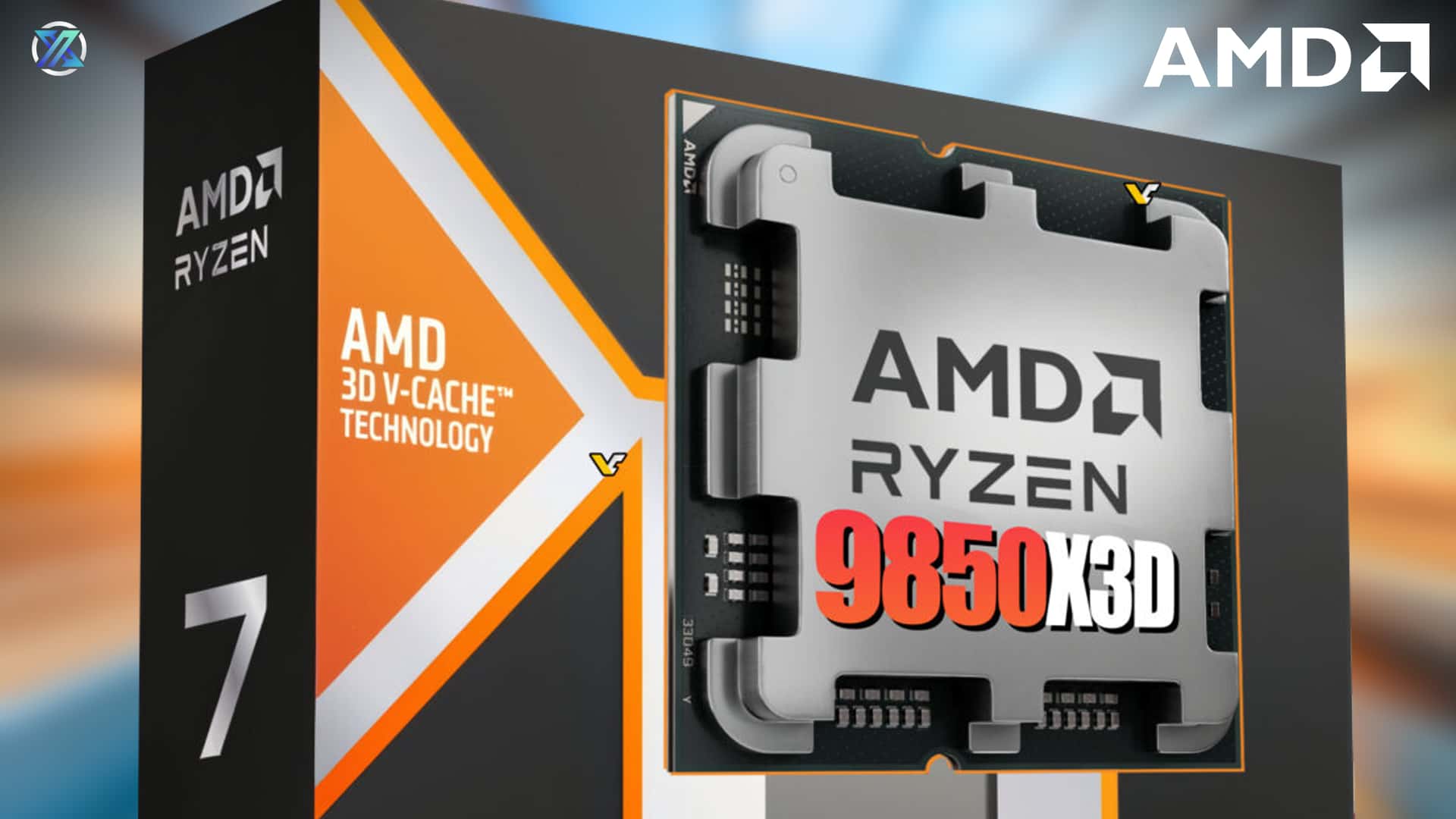
The rise of AMD's next generation CPU in the world of rapid evolution has begun, and the whispering about the Ryzen 9 9850X3D has the brightest light upon it, a very powerful CPU that is anticipated to repeat the boundary break of gaming and productivity.
If the newest leaks turn out to be true, the chip will be based on Zen 5 and will have clock speed up to 7.7% higher than its predecessor, besides significant gains in cache efficiency, signal handling, and AI-accelerated performance.
AMD is still busy improving its 3D V-Cache technology, but already the 9850X3D is seen as an important CPU for the ones who like the highest quality of performance be it gamers, creators, or professionals.
The Clock Speed Boost : Why 7.7% Matters More Than It Sounds?
A 7.7% increase in clock speed may not sound too severe at first, but it is a great leap in the CPU architecture world, where gains usually come in small bits. The supposed 9850X3D clock shift is different from the regular small incremental changes because higher base and boost frequencies are directly linked to smoother gameplay, faster processing, and better multitasking performance.
The last generation, including 7800X3D and 7950X3D, took over the benchmarks mostly because of their huge cache advantage, not raw frequency. If AMD pairing high clocks with excellent cache layers, then the output is likely a chip that not only closes the gap but also makes it harder for Intel processors to beat, especially in games where every millisecond in latency counts.
The 3D V-Cache already produces the best frame rates, but when combined with higher speeds, the 9850X3D might just become one of the fastest gaming CPUs ever produced by humans.
3D V-Cache Evolves Again : What to Expect from the New Stack?
AMD's 3D V-Cache has been the main factor of the company's victory over Intel in gaming performance. The 9850X3D is likely to come up with an advanced version of the cache technology that is used to stack memory vertically, thus granting quicker access to data and better memory bandwidth.
Rumor has it that the chip may come with :
- More stackable cache layers owing to better bonding techniques
- Less power consumption for each instruction
- More even heat distribution throughout the stack
This is important because earlier X3D chips had to give up on their full potential clock speeds for longer periods owing to the large cache layers that were their thermal bottlenecks. If AMD has managed to cool the CPU effectively, then it will be able to turbo clock its processor much higher and thus will have the ability to offer enhanced stability and long-range output even during the heaviest of tasks such as rendering, simulation, or even esports gaming exhausting the total power of the CPU and GPU combined.
Moreover, the enhanced cache system could also be beneficial for the AI application that is being trained for a specific scenario, especially if AMD provides the Zen 5 architecture with an improved NPU or AI acceleration units.
Zen 5 Architecture : A Strong Foundation for Higher Gains
The new AMD 9850X3D processor is built on the cutting-edge Zen 5 architecture, which has also been lauded for its revolutionary execution units, bigger buffers, and better branch prediction. Zen 5 isn’t just a minor enhancement, it's a full architecture redesign aiming at reducing latency while increasing instruction throughput.
The speculated improvements are as follows :
- Better single-core IPC gains
- A newly designed front-end for quicker data fetching
- Improved multi-threading efficiency
- More power efficiency per core
Even without the additional clock speed boost, the 9850X3D's entire array of new features already marks it as a vastly superior processor compared to its Zen 4 predecessors. With the 3D V-Cache, the Zen 5 architecture could prove to be AMD's most versatile cycle, providing gamers and professionals the best of both worlds.
Gaming Impact : A Potential New King of FPS Performance
Without considering its potential gaming impact, the discussion on 9850X3D cannot take place. In particular, AMD’s X3D chips have proven time after time to be the first choice for the gaming segment offering the best FPS, thus bringing advantages in CPU-dependent video games like simulation games, competitive shooters, and open-world RPGs.
The speculations about the improvements suggest :
- Higher FPS in CPU-intensive games
- Reduced microstutters due to better cache distribution
- Improved performance in poorly optimized or legacy game engines
- Smoother frame pacing in esports titles
The performance upgrades in the areas of clock speeds and cache layers are expected to benefit highly the titles like GTA V, Starfield, Baldur’s Gate 3, and Microsoft Flight Simulator. Competitive players may also notice a practical difference in the 240Hz to 500Hz gaming setups, where even small latency cuts make a difference that can be seen.
If the benchmarks are in line with the past X3D patterns, the 9850X3D will not just once again take down every Intel gaming CPU, including the ones from future Meteor Lake or Arrow Lake refreshes, thus confirming AMD’s supremacy in this segment.
Content Creation and Productivity : Beyond Just Gaming Power
The X3D series has always been a standard in gaming, however, the professionals and creatives have started to use the CPUs because of their balanced efficiency. Among others, the 9850X3D is anticipated to be in the :
- Video editing and encoding
- 3D rendering
- Simulation workloads
- Software development
- Large dataset handling
- AI-assisted creative processes
The Zen 5 architecture has better multi-thread scaling, and with higher clocks, it means that the timeline scrubbing is quicker, rendering times are shorter, and multitasking is more efficient.
Non-X3D models might still be the kings of productivity, but the 9850X3D could position itself very well by giving great gaming performance and at the same time not losing much in the area of the creator-focused capabilities.
AMD's additional integration will only contribute to the already high chip workstation potential with the increasing involvement of AI in creative industries.
Pricing, Competition and What This Means for Intel
What is the ultimate price to be paid for the Ryzen 9 9850X3D by AMD is the major question at the moment? The previous X3D models were released at premium prices, so the launch of the 9850X3D will most probably be at the same high price. The additional cache layers, along with the AI acceleration features, add to the complexity of the manufacturing process, thus pointing to the price being quite close to the upper end of the consumer CPU spectrum.
In the meantime, Intel is in a tough spot. Despite Intel's Arrow Lake series being predicted to come up with a better performance, AMD's X3D chips keep outperforming Intel in gaming, which is the most prominent and demanding segment of the CPU market. In case AMD actually grants a clock uplift of 7.7%, gains in Zen 5 efficiency, and next-gen cache improvement, then Intel will be in the same position of having to catch up again.
Consumer perception is already on AMD's side, as they enjoy the steady efficiency improvements, and being cooler during operation, in the long run, with AM5 socket support. On the other hand, the constant socket changes and higher power draw coming from Intel are still leading to criticism from the PC builders' side.
Final Thoughts : The 9850X3D Could Be AMD’s Next Masterpiece
AMD Ryzen 9 9850X3D is becoming the most talked about processor of the new generation. Along with a possible 7.7% clock increase, next-gen V-Cache, and Zen 5 improvements, its performance in thermal management will also be quite good. The CPU is going to be very powerful for gaming and to be a good device for the creators and professionals due to its versatility.
On the one hand, if the leaks turn out to be true, AMD could very soon have a CPU that would set no limits for what is possible on consumer desktops, a mix of raw power, cutting-edge engineering, and efficiency, none the less an eco-friendly powerhouse chip. While we are still waiting for the next official announcement, it’s pretty much clear that the new era of X3D performance is dawning, and it might again change the landscape of the high-end CPU market.